Beretta Pico Semi-automatic Double Action Only Sub Compact 380acp Review
This review of the Beretta Pico appeared originally in the February 2015 consequence of American Rifleman. To subscribe to the mag, visit the NRA membership page here and selectAmerican Rifleman equally your fellow member magazine.
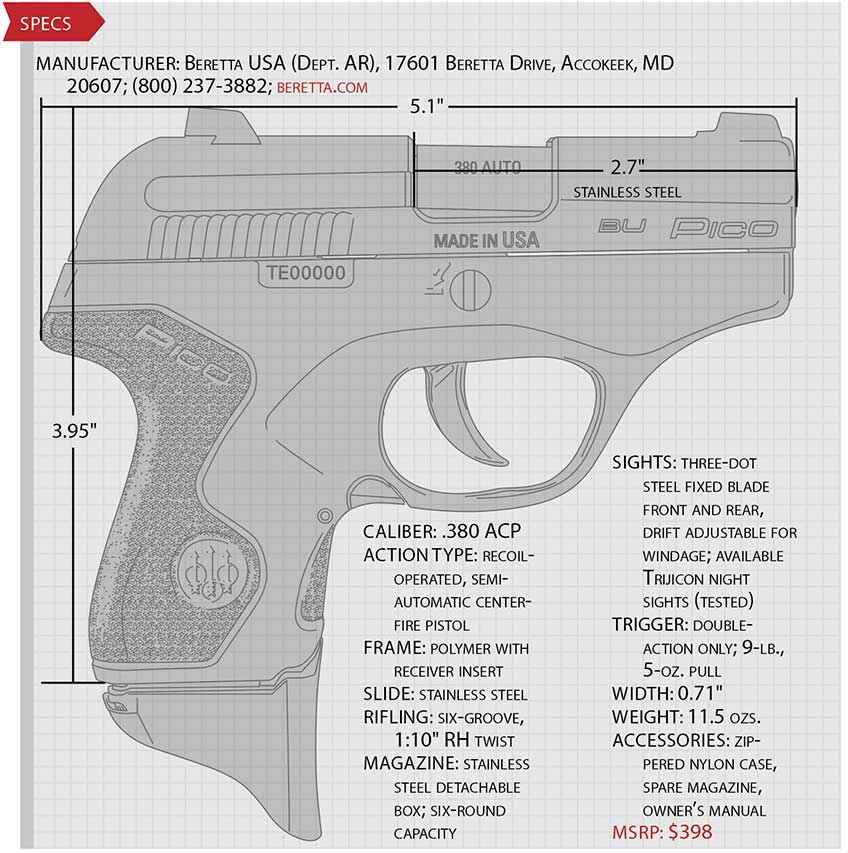
When it comes to curtained-deport handguns, smaller is by and large considered better. And while Beretta isn't claiming that its Pico .380 ACP is the "smallest" of its type on the marketplace, it does say that it is the "thinnest," with a width of 0.71". This critical dimension is key to comfy concealed acquit, which is precisely the part for which the Pico is designed.
The Pico is a U.South.-fabricated, lightweight, compact and simple-to-operate semi-automatic handgun that uses a combination of steel and polymer components to achieve its size and weight goals. Information technology is a close cousin both in design and operation to the 9 mm Luger-chambered Beretta Nano. Beingness a handgun designed with concealed carry in heed, it is difficult to observe a precipitous border on the Pico—nearly every contour and surface is rounded to preclude snagging on wear. The polymer frame is removable from the serial-numbered metal "chassis," and tin can be easily exchanged for accompaniment frames in different colors.
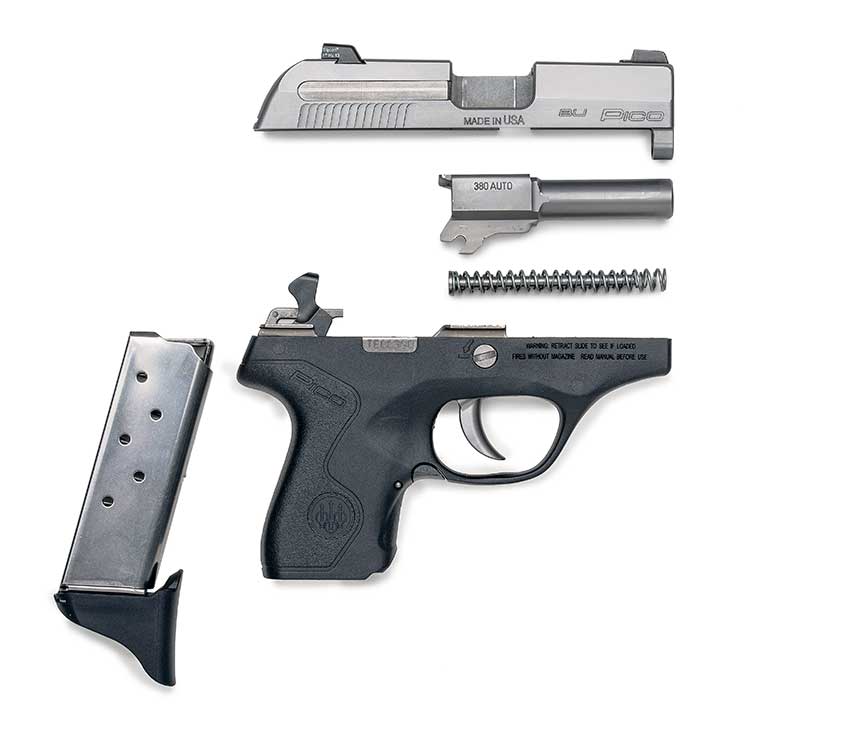
Disassembly of the Pico requires the user to rotate the slotted takedown screw counterclockwise for slide removal, at which point the recoil spring assembly and barrel can be removed.
Functioning of the Pico is straightforward and similar to that of most modern semi-automatic designs. The two included stainless steel magazines each have a chapters of six rounds. One of the magazines fits flush with the frame to minimize external dimensions while the 2d's polymer base plate extension allows the shooter to accomplish a full-handed grip on the handgun. The Pico does not have a magazine disconnect, so the pistol can be fired without a mag in place. The merely manual controls on the Pico are an ambidextrous magazine release and a left-side slide finish; there is no manual safety. The magazine release is actuated by pressing a pocket-size tab at the bottom rear of the trigger baby-sit down, which allows both loaded and unloaded magazines to driblet complimentary from the frame when the pistol is held upright. The magazine take hold of is challenging to engage under stress; our suspicion is that Beretta's engineers wanted to limit inadvertent user-induced magazine drops, rather than heighten speed of operation.
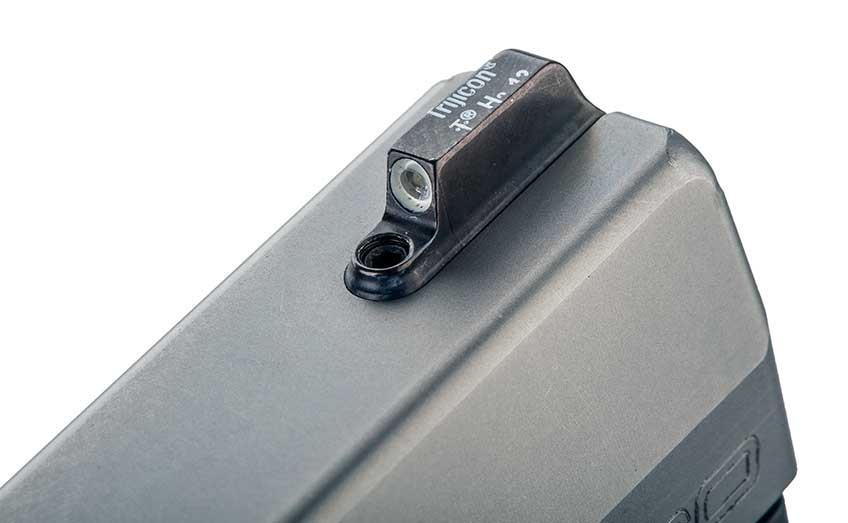
The Beretta Pico is fitted with steel Trijicon front and rear night sights.
The steel slide cease simply protrudes from the frame past a hair, yet nosotros never missed it with our thumbs during our range testing. Information technology can exist used both to release the slide when a magazine is inserted as well as to lock the slide rearward; the slide locks back automatically on an empty magazine.
Operating the Pico's slide chambers a round but does not cock the shrouded hammer, the handgun operates as a double-action merely. The trigger pull on the Pico is long and, at nearly ten lbs., fairly heavy. Such a pull is not necessarily out of place on a handgun designed to be carried loaded without the balls of a manual safety. Since the trigger pull both cocks the hammer and releases the sear, the trigger reset on the Pico is nearly as long as the initial trigger pull. Despite the weight and elapsing of the trigger pull, the Pico was piece of cake to shoot well at brusque-range targets—this is a firearm intended for defensive use, not target shooting.

The rear sight on the Beretta Pico is adjustable for windage.
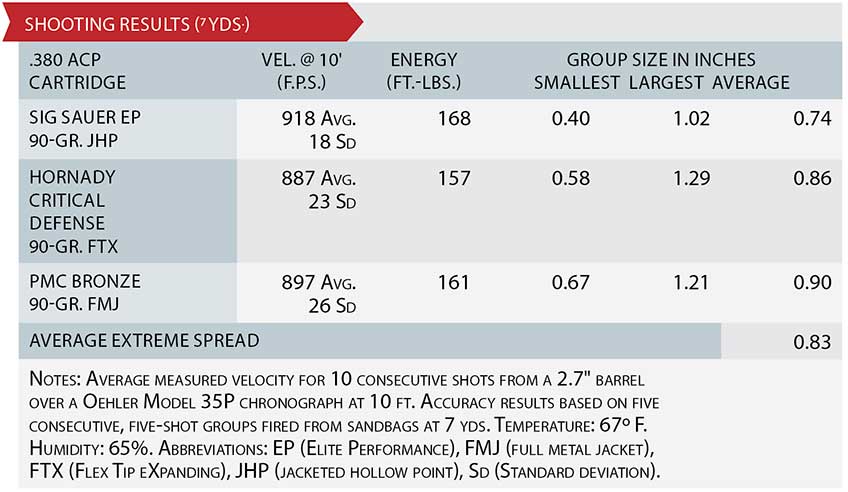
The Pico'southward three-dot steel sights are secured in their slots by screws, and Trijicon night sights, such as those shown on the test gun, are available as accessories and are easily installed by the user without special equipment. Accuracy was first-class for a handgun of any size, much less a pocket .380, with 7-yd. groups rarely exceeding one ragged hole. Recoil was balmy, aided no doubt past the nested recoil springs attached to the full-length stainless steel guide rod.
We experienced three failures to extract during our accuracy testing, all with the SIG Sauer Elite 90-gr. jacketed hollow-signal load. Clearing the malfunction required removing the magazine, racking the slide to remove the fired case and reinserting the magazine earlier cycling the slide to reload the chamber.
The Pico is disassembled past rotating the slotted takedown screw on the right side of the frame counter-clockwise. The slide moves forward and off the frame rails, allowing the recoil leap assembly and barrel to exist removed. Reversing the procedure reassembles the firearm and the disassembly/reassembly takes mere seconds. When the slide assembly is placed back on the frame and brought to the rear, the takedown screw automatically snaps dorsum into the "locked" position. Disassembling and reassembling the Pico reveals well-constructed components that fit together with precision.
The cavernous hollow points of the SIG Sauer ammunition also resulted in a sharp edge on the cartridge's nose that required some coaxing to get into the chamber on the first circular of each mag. The pointed elastomeric tip Hornady Critical Defense FTX and circular-olfactory organ PMC total-metal-jacket loads fed, fired and ejected without incident. Small guns can be ammunition-sensitive, and information technology appears the Pico is no exception.
A gun that is truly concealable, reliable, condom and reasonably accurate is platonic for daily defensive deport. Incompatibility with one ammunition type aside, the Beretta Pico meets each of those criteria.
spellmanaffew2001.blogspot.com
Source: https://www.americanrifleman.org/content/beretta-pico-review/
0 Response to "Beretta Pico Semi-automatic Double Action Only Sub Compact 380acp Review"
Post a Comment