When Will the Tunguska Meteor Hit Again
NEWY'all tin can now heed to Trick News articles!
The Tunguska effect, a seismic blast that rocked a remote Siberian wood more a century ago, is believed to have been acquired past a falling star that exploded before it hitting the ground. A new study sheds more light on the asteroid, noting information technology may have never actually hit Earth at all.
The research, published in Monthly Notices of the Imperial Astronomical Society, theorizes that the asteroid caused a shock wave that resulted in well-nigh 800 square miles in the Siberian forest to exist flattened within seconds, but it never actually hitting Earth, every bit it curved abroad shortly before breaking up, continuing into infinite.
"We argue that the Tunguska event was caused by an atomic number 26 asteroid body, which passed through the Earth'due south atmosphere and continued to the virtually-solar orbit," researchers wrote in the study'due south abstract.
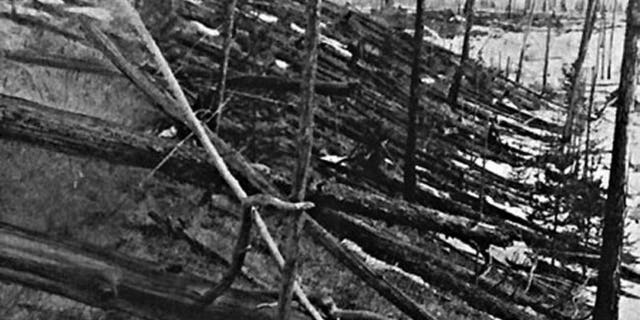
Aftermath of the Tunguska event. (Credit: AP)
MYSTERIOUS INTERSTELLAR 'OUMUAMUA COULD BE MADE OF SOMETHING ALMOST UNHEARD OF IN Science
The 1908 blast is by and large estimated to have been about x megatons. No injuries were reported, just some 80 million copse over approximately 800 foursquare miles were leveled.
The researchers, including co-writer Vladimir Pariev, looked at a number of different calculator models, testing objects equally modest as 164 feet beyond all the way upward to 656 feet beyond, comprised of rock, ice or iron. They were also given dissimilar trajectory paths that brought them within vi to 10 miles of the World's surface.
The rock and ice objects disintegrated in the Earth'south atmosphere, but the iron object did not.
"Simply asteroids made of iron larger than 100 yard [328 feet] in diameter tin survive and not get cracked and fragmented into many split pieces," the researchers said in comments obtained by LiveScience.
"Probably, the most realistic version explaining the Tunguska phenomenon is the through passage of the iron asteroid trunk equally the most resistible to fragmentation beyond the World'southward atmosphere at a minimum distance of x–15 km with the length of the trajectory in the atmosphere of about 3000 km and a subsequent go out of this asteroid body into the outer infinite to the near-solar orbit," the researchers wrote in the study. "This version is supported by the fact that in that location are no remnants of this trunk and craters on the surface of the Earth."
The researchers gauge the meteor was likely flying at a speed of 45,000 mph, hitting the atmosphere at a shallow bending, somewhere betwixt ix and 12 degrees. If information technology were comprised of atomic number 26, some of the iron would have escaped as a gas and plasma and become almost impossible to find or differentiate betwixt terrestrial fe oxides, the study added.
No fragments of an asteroid or comet accept e'er been found.
Information technology'due south unclear the size of the impact an iron meteor that "grazed" the Globe could produce, but Pariev told LiveScience in an e-mail the research found the estimates (betwixt 328 and 656 feet in diameter) could exist powerful enough to flatten trees and cause the damage seen in the Tunguska event.
"Detailed calculations of the shock waves from a grazing asteroid is the subject area of our ongoing research," Pariev added in his email.
Behemothic ASTEROID THAT KILLED THE DINOSAURS SLAMMED INTO Globe AT 'DEADLIEST POSSIBLE ANGLE,' STUDY REVEALS
The explosion well-nigh the Podkamennaya Tunguska River on June 30, 1908, reportedly flattened some 500,000 acres of Siberian forest. Scientists calculated the Tunguska explosion could have been roughly as strong as xx megatons of TNT, or roughly i,000 times more powerful than the atomic bomb dropped on Hiroshima.
In 2013, a meteor entered the Earth's temper on February. fifteen, 2013, over Russian federation and crashed, an occurrence now known as the Chelyabinsk Consequence.
The result of the explosion caused impairment to more vii,200 buildings and resulted in nearly 1,500 injuries, though none of them were fatal.
CLICK Hither TO Become THE Play a joke on NEWS APP
spellmanaffew2001.blogspot.com
Source: https://www.foxnews.com/science/tunguska-event-iron-asteroid-went-back-into-space
0 Response to "When Will the Tunguska Meteor Hit Again"
Post a Comment